The History of the Fisherman's Gansey Sweater
Pull on a gansey and you're wearing something closer to a tool than a fashion statement. Every element of this densely knit, weatherproof pullover was shaped by the punishing demands of working on cold water, and its story stretches back further than most knitters realize.
Where the Name Comes From
The word "gansey" is a worn-down version of "guernsey," named for Guernsey in the Channel Islands. The islands had a thriving knitting trade going back to the 1500s, when Guernsey knitters produced fine worsted stockings and undergarments so prized that they reportedly clothed royalty, including Elizabeth I. By the late 1600s, thousands of islanders worked in the trade, turning wool into a genuine export economy.
The jumper we'd recognize today as a gansey emerged later, documented under names like "guernsey jacket" and "guernsey frock" in the 1800s, though garments like it likely existed before written records caught up. From there, the style and the name spread outward along Britain's coastline and into fishing communities in Scotland, Ireland, and the east coast of England, where it became simply "the gansey" regardless of which island it traced back to.
Interestingly, some gansey historians push back on the idea that the garment originated in Guernsey at all, arguing instead that gansey-style sweaters developed in parallel across the North Sea fishing world, worn by British and Dutch fishermen alike, and that untangling one true point of origin may be beside the point. What's clear is that Guernsey's stocking-and-jumper trade was influential enough to lend the whole tradition its name.
Built for the Sea, Not for Show
Long before "performance wear" was a marketing term, the gansey was doing that job. Fishing was, and remains, dangerous, wet, cold work, and a garment that failed you at sea was more than an inconvenience.
Ganseys were knitted tightly, often on five fine needles, in a hard-wearing worsted wool. That density mattered: a tight gauge traps less wind and sheds water better than a loose, airy knit, which made all the difference for men standing on open decks in the North Atlantic. The wool itself typically retained some of its natural lanolin, adding a degree of water resistance the knitting alone couldn't provide.
Construction was just as purposeful as the fabric. Ganseys were knit seamlessly in the round from the hem upward, which meant no side seams to strain, gape, or let in water. At the underarm, knitters worked a small diamond or triangle of extra stitches known as a gusset. This simple addition gave the sweater room to move with a fisherman's arms as he hauled nets and lines all day, and it reinforced one of the highest-stress points on any pullover. Historians of the craft point to the underarm gusset as one of the gansey's most quietly brilliant engineering details, solving a durability problem hundreds of years before set-in sleeves became the default in mass-produced knitwear.
Practicality extended to the design of the whole garment. The lower body and sleeves were often worked in plain stockinette, easy to reknit or repair when they wore through, while the patterned, more labor-intensive stitching was concentrated on the yoke, chest, and upper sleeves, exactly where a rope-hauling fisherman needed the extra insulation and padding most.
The Patterns: Ropes, Waves, and a Little bit of Legend
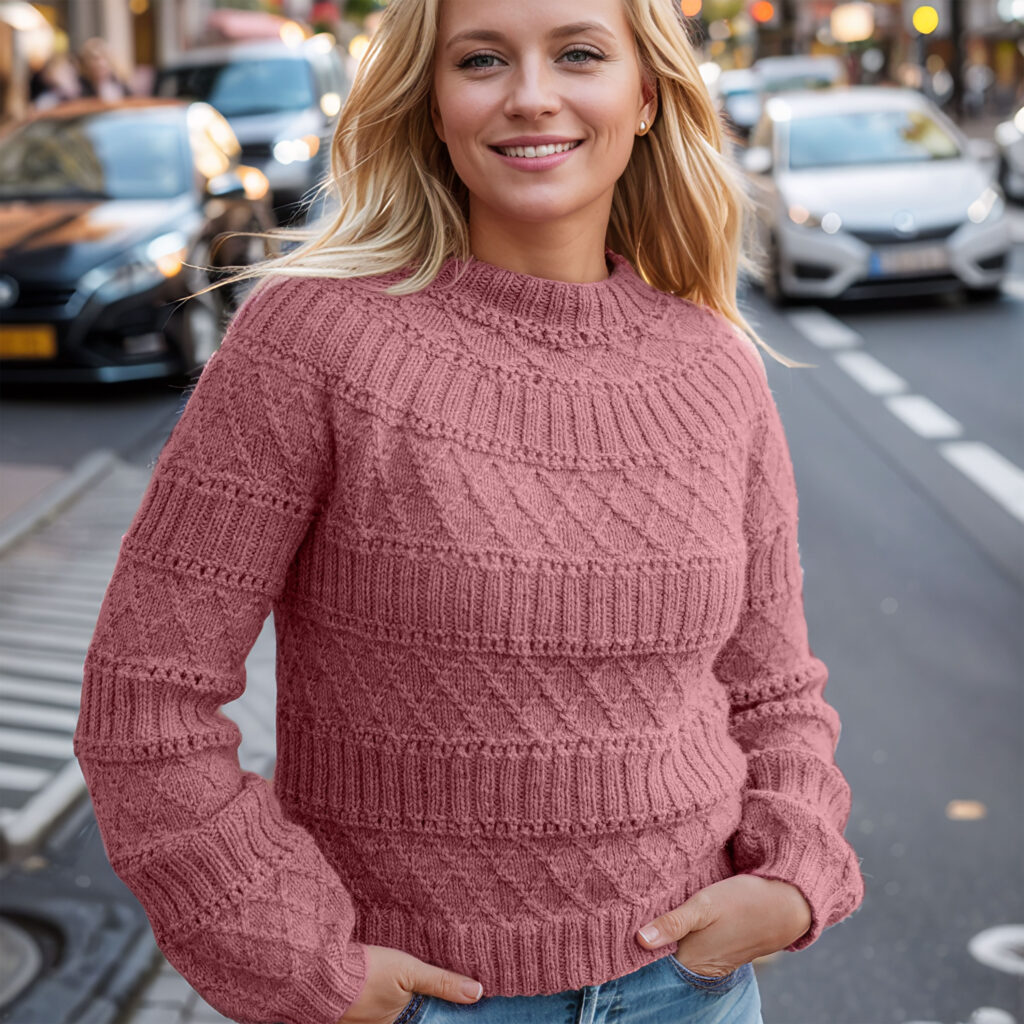
Look closely at a traditional gansey and you'll often find a vocabulary of texture rather than color: cables that echo twisted rope, zigzags suggesting waves or nets, seed stitch mimicking sand or pebbles, and diamond motifs associated with fishing nets themselves. These weren't just decorative choices. For knitters working entirely by feel, often by firelight or on the walk to market, textured stitches were faster to track than colorwork and produced a naturally more insulating, three-dimensional fabric.
Here's where the history gets more interesting, and where popular retellings tend to run ahead of the evidence. You'll frequently hear that every fishing village had its own unique, unchanging gansey pattern, and that this was useful for a grim reason: identifying the bodies of drowned fishermen who couldn't otherwise be recognized. It's an evocative story, and it isn't entirely without basis, but knitting historians who've dug into the record treat it with real caution.
Regional styles absolutely existed and can still be recognized today: a Sheringham gansey looks different from one out of Filey, and the Eriskay gansey developed its own distinctive two-part pattern, though that particular design only emerged around the 1930s, much later than the romantic version of the story implies. But the idea of one fixed, exclusive pattern per village doesn't hold up well. Knitting patterns traveled constantly, carried by the "herring girls," the thousands of women who followed the fishing fleets seasonally down the coast gutting and packing fish, and who swapped stitch patterns as freely as gossip along the way. Many working ganseys, especially earlier ones, were plain or commercially knitted rather than intricately patterned at all. And gansey researchers who have interviewed knitting families directly note that most fishermen lost at sea were never recovered in a state where any clothing detail would have mattered, which undercuts the tidy identification story considerably.
A more accurate way to hold this: patterns often did carry personal and family meaning, and a wife or mother might well recognize her own handiwork on a garment. But the leap from "a knitter could recognize her own work" to "every village had a registered, exclusive design" is where legend has outpaced the historical record, in much the same way the identically romantic claim gets made about Ireland's Aran sweaters.
From Working Garment to Enduring Craft
Ganseys had their heyday roughly from the early 1800s through the years just after World War II, tracking closely with the rise and fall of Britain's great herring fishing industry. As industrial fishing changed and mass-produced foul-weather gear became available, the everyday working gansey gradually faded from harbors and decks.
What survived is the knitting tradition itself. Hand-knitting a full gansey is a serious undertaking, often quoted at somewhere around 80 hours of work, and that investment of time is part of why the style has endured as a craft heritage piece long after it stopped being standard-issue fishing wear. Contemporary knitters return to ganseys for exactly the reasons that made them work in the first place: the meditative rhythm of knitting in the round, the satisfaction of a seamless, thoughtfully engineered construction, and a set of textured stitch patterns that connect a modern sweater to more than two centuries of working history.
The gansey's real story is less a fairy tale than a working history: a garment refined by generations of knitters solving practical problems with wool and patience, its details worn smooth by memory the way sea glass is worn smooth by tide. That it also picked up a legend or two along the way only proves how much people have always loved a good sweater story.