# The History of the Aran Sweater: Fact vs. Legend
Ask most people what they know about the Aran sweater, and you'll hear some version of the same story: that off the windswept Aran Islands, each fishing family knitted its own secret pattern of cables and honeycombs, generation after generation, so that if the sea ever took one of their men, his body could be identified by the stitches on his sweater.
It's a haunting image — and it has sold an enormous number of sweaters. It is also, according to the knitting historians who have actually dug through the archives, almost certainly not true. The real story of the Aran sweater is younger, more surprising, and in its own way just as compelling: a tale of poverty relief schemes, enterprising shopkeepers, a Dublin social reformer, a folk-singing act on American television, and one very persuasive yarn-shop owner who may have invented the legend that made the sweater famous.
Here's what actually happened — and what's popular myth.
A Tradition Younger Than You'd Guess
The Aran Islands — Inishmore, Inishmaan, and Inisheer, scattered at the mouth of Galway Bay — have a knitting history, but it doesn't stretch back into the Celtic mists the way gift-shop brochures like to suggest. Historians who have traced the sweater's origins, including Vawn Corrigan, author of a detailed history of Aran knitting, generally place its emergence in the 1890s to early 1900s, not centuries earlier. The island's earliest known example in the National Museum of Ireland's collection dates only to 1937.
That timing isn't a coincidence. In the 1890s, the Congested Districts Board — a British-run development agency trying to shore up the economies of Ireland's poorest, most crowded coastal regions — was actively working to modernize fishing and cottage crafts along the west coast. Fishermen and their families from Scotland and England, who came to the area for herring season, brought with them the plain, tightly-worked pullovers known as ganseys. Local women adapted the idea, using heavier, unwashed wool that still held its natural lanolin (handy for shedding rain and sea spray) and building it out with the elaborate, raised stitch patterns the Aran style is known for today. Historian and knitwear designer Alice Starmore's research points to the same window, arguing persuasively against any older, unbroken folk tradition.
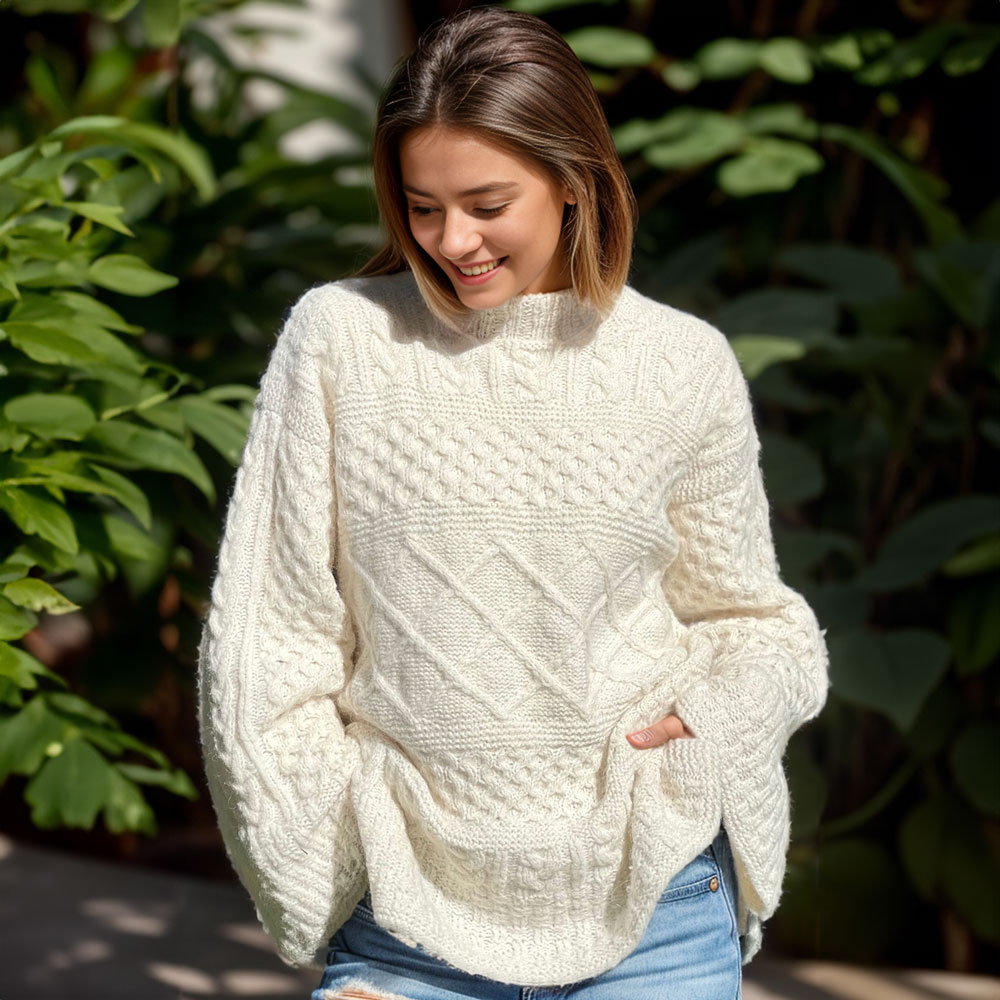
By most accounts, the sweater as we'd recognize it — heavily patterned, cream-colored, cabled all over — really came together around the 1930s. Dublin shopkeeper and social reformer Muriel Gahan is often credited with commissioning early versions and selling them through her cottage-industry shop, Country Workers Ltd, giving island knitters a source of income beyond fishing and farming.
How It Left the Islands and Conquered the World
An Aran sweater knitted for local use is one thing; an Aran sweater knitted for export is another, and it's the export trade that turned a regional garment into a global icon.
Commercial knitting patterns for an "Aran style" jumper began circulating in Britain by the 1940s, letting knitters far from Galway Bay try the technique at home. Vogue put the look in front of a fashion-conscious readership in the 1950s. Around the same time, businessman Pádraig Ó Síocháin built an export operation — organizing island knitters, standardizing sizing, and commissioning artwork to market the sweaters to buyers in the United States and beyond.
Then came the moment that arguably did more for the sweater's fame than any marketing campaign: in 1962, the Clancy Brothers and Tommy Makem performed at Carnegie Hall in cream Aran sweaters, and their subsequent television appearances — including on The Ed Sullivan Show — put the garment in front of millions of American viewers as a symbol of romantic, rugged Irishness. The look also reached the White House era of Irish-American style associated with the Kennedy family, and by the 1960s it had worked its way into high fashion, appearing in runway collections and eventually earning a place among the pieces the Museum of Modern Art has recognized as culturally significant twentieth-century fashion. What started as practical knitwear for fishing families had become shorthand for Irish heritage itself.
The Legend of the Clan Patterns
So where did the story about identifying drowned fishermen by their sweaters actually come from?
Most of the trail leads to one man: Heinz Edgar Kiewe, a German-born yarn shop owner working in England, who wrote about Aran knitting in the mid-twentieth century, most notably in his 1967 book *The Sacred History of Knitting*. Kiewe proposed that Aran stitches descended from ancient Celtic art and carried sacred, even biblical, meaning — an appealingly romantic theory that had little basis in the historical or archaeological record. Historians including Richard Rutt, whose *A History of Hand Knitting* remains a standard reference in the field, along with Starmore and Corrigan, have since examined and rejected Kiewe's claims.
The specific idea of *family-identifying* patterns likely has a literary rather than historical source: J.M. Synge's 1904 play *Riders to the Sea*, in which a drowned man is identified by a dropped stitch in a stocking he was wearing — a small, fictional detail about knitting that, over decades of retelling, seems to have been transplanted onto Aran sweaters and inflated into a whole system of clan-specific cable patterns. It's a good story. It just isn't documented history, and no verified nineteenth- or early-twentieth-century source describes Aran families using unique patterns for identification.
None of this means the myth was pointless or cynical. It gave a beautiful, labor-intensive garment a story worth telling, and it undoubtedly helped sell sweaters to a world hungry for a connection to something old and meaningful. Understanding it as folklore-turned-marketing doesn't make the sweaters any less remarkable — it just means the meaning was added after the fact, not passed down with the stitches themselves.
What the Stitches Are Popularly Said to Mean
Even without documented ancient origins, the symbolism attached to individual Aran stitches has become part of the garment's identity, and it's worth knowing what's traditionally claimed — with the understanding that these are the poetic meanings assigned during the sweater's twentieth-century rise to fame, not inherited ancient symbols:
- Cable stitch — said to represent fishermen's ropes, and by extension a wish for safety and a good catch at sea.
- Diamond stitch — popularly linked to the small, diamond-shaped fields enclosed by stone walls on the islands, symbolizing wealth, land, and success.
- Honeycomb stitch — said to stand for the hardworking bee, and the reward that hard work brings.
- Moss stitch (also called blackberry stitch in some patterns) — associated with the abundance of the land and sea, or simply the moss and lichen on the islands' stone walls.
- Tree of Life — perhaps the most evocative motif, said to symbolize family, long life, and the branching connections between generations.
- Trellis or basket stitch — linked to the fisherman's basket or creel, representing hope for a bountiful catch.
Whether or not these meanings are centuries old, they've become a genuine part of Aran knitting culture over the past several decades — a shared vocabulary that knitters and wearers alike still use to talk about the craft. Treat them as the story that grew up around the sweater rather than a code it was originally knitted in, and they lose none of their charm.
Why the Legend Still Matters
There's something fitting about the fact that a sweater built for hard, practical work — for standing on a pier in Galway Bay wind — ended up wrapped in one of knitting's most enduring legends. The Aran sweater's real history is, if anything, more impressive than the myth: it's a story of women turning a local craft into a livelihood during genuinely difficult economic times, of a small export business turning island wool into an international fashion statement, and of a garment resilient enough to survive being both working-class gear and high fashion within the same century.
Next time you cast on an Aran-style piece — or reach for one on a cold morning — you can enjoy the story of clans and drowned fishermen for what it is: a beautiful piece of twentieth-century folklore. And you can appreciate the real history underneath it, which needed no embellishing to be worth telling.